The Podcasting Bug – Part 2

Making it Happen

Yesterday I talked at length about the design that goes into a podcast.  While sure some people quite literally just start recording without much forethought, the best and most successful podcasts put quite a bit of effort into figuring out just how they want to go about the process of making their vision come to life.  No matter how much prep work goes into the planning, there comes a point where you have to sit down and functionally record your podcast, and there are all manner of issues that arise.  Most of us that go down this path lack the formal training with audio engineering to fall back on, so there is quite a bit of “sink or swim” that happens.  Having gone through some of these decisions myself I thought I would talk about some of the hurdles that comes from the recording and editing of your podcast.

Recording the Podcast

The hardest part of the equation quite literally is how exactly you are going to record.  If you can get all of the people you are needing to record in the same room it is a relatively easy situation of setting up a bunch of USB microphone inputs and having them all get recorded by a single piece of software.  The problem being most podcasters have no physical contact with their co-hosts meaning that we are somehow going to have to make this whole thing work over the internet.  When dealing with the internet you have all the standard problems of latency and network stability.  Today I am going to cover some of the methods of recording remotely that I have seen or heard working very well.

The Skype Standard Method

Skype has managed become the gold standard as far as internet telecommunications software goes.  While this started off as a relative rogue horse with the acquisition by Microsoft it has become absolutely ubiquitous.  The problem being…  it was not designed to record audio with.  In fact Skype has no default method for recording either side of the conversation, and I would assume this is by design to keep away from any potential legal hurdles.  The other negative is that excellent sound recording software like Audacity was not designed to work with something like Skype.  As such you have to figure out how precisely you are going to make this work.  Essentially the first hurdle you have to decide is if you are going to try and record individual speaker tracks or if you are going to record the resulting mixed audio.

Single Audio Tracks

Recording individual audio tracks is without a doubt the “purest” method of recording a podcast.  This means each person is recorded separately and then can be mixed at a later date to create the final merged product.  This means you can do all manner of post processing on audio levels, clearing up jitter and pops without effecting the integrity of other tracks.  The problem is…  isolating each speaker.  There is software that will supposedly help you with this method but more than likely you are going to need to do a significant amount of research and testing to get it working correctly.  The most tried and true method that I know of for this is the “everyone records themselves” method.  Meaning that essentially each participant launches their audio recorder of choice and at the end of the show passes off their audio track for editing in later.  There are a number of issues with this concept, not the least of which is that uncompressed waveform audio is way the hell too large to email.  Secondly editing in multiple tracks is a mind numbingly boring process.  If you record an hour long show expect to spend one hour per participant plus another hour or two on miscellaneous issues while trying to merge all this audio together by hand.

Merged Audio Tracks

The far more common method is that you simply “get everything right” before you start recording and record one merged audio track that represents the basis of your podcast episode.  Generally speaking this involves getting a test call going first, and then setting up again to record the “real call” that will be the final product.  Of note… my experience with Skype comes from co-hosting on other podcasts, and I chose not to go with this method myself.  Some of my advice may not be absolutely accurate so before you set down this path do some legwork and research it yourself.  The idea is that you start a Skype call and then have a third party software “catch” the audio and record it.  Since this has become the default way of doing podcasts for many people you can imagine there are a lot of options out there for recording.  Here is some of the software I have heard decent things about.

Voice Server Method

The method that I never really hear anyone talking about that has worked very well for me personally is recording off of a voice server.  Both Teamspeak and Mumble offer the ability to record client side audio of what is actually being said on the voice server.  Both servers we have used had their positives and negatives.  The key negative of mumble is that all of the audio is recorded in a mono format, making the sound a bit hollow.  The positive there however is that you could choose to record each participant to their own audio file allowing you to merge them together manual later.  Teamspeak offers stereo output but merges all speakers into the same audio stream.  Ultimately you have some of the same issues that arise with Skype in that you need to make sure that all of your speakers are as “clean” as possible before you actually record.  Since we record on the voice server that we quite literally hang out on every single night, then this portion was pretty simple for us.  There are a few things you really need to think about before going down this path.

Audio Codecs Supported

The server that we happen to record on supports a large number of audio codecs.  This allowed me to set up a custom server channel and tweak the audio settings until I got a product that I was happy with.  Currently the channel we record in uses the Opus Voice codec with a quality rating of 8, and this is something we had to tweak down a bit until we found a happy place.  In order to maintain that quality of stream you need an uninterrupted 7 KB/s transmission but thankfully for the most part all of our participants have really solid internet.

Lock Down Your Channel

If you are going to record on an existing server that is already active, it is important that you have to lock down your channel.  It is extremely easily for some well meaning person to pop into your channel out of curiosity and completely destroy your podcast.  In theory you could get by with just naming your podcast channel something obvious like “Podcast Channel”, but I suggest taking the extra step of password protecting the channel.  This allows me to hand the password out to regular guests and simply drag limited hosts into the channel manually.

Turn Off All Audio Queues

This one is absolutely important.  Sure it is nice to know when someone leaves or joins the server but for the purpose of recording a podcast make sure you turn off all of this stuff.  Someone popping on and off the server will be recorded in your final output stream.

Priority Speaker

This one has bit us in the ass a few times, but if your voice server uses a priority speaker system… make sure that ALL participants in the conversation are artificially elevated to priority speaker status.  How priority speaker works is that it essentially lowers the volume of low priority speakers to make sure that the priority one is heard.  This works great in a raid situation where one person needs to be delivering orders, this does not work well when you are expecting multiple people to be chiming in on a conversation.  I am administrator on our voice server so I cannot turn off priority, so I just elevate everyone else to the same level while in the podcasting channel.

Google Hangouts Method

This is the method I honestly know the least about but I believe this is how Cat Context has been recorded for eons.  You can check out this guide but I will try and cover the basics.  The idea is that you start a Google Hangout On Air inviting all of the members of the show.  This is recorded and afterwards you can export the video in MP4 format.  From there you can take the MP4 and edit in an audio editor like Audacity and extract the audio only portion that then becomes your podcast.  The benefit here is that instead of only having audio you also have video recorded of the hangout that can be uploaded to a service like YouTube allowing you to tap into a completely different audience from the traditional podcaster one.  The negative is that you are putting all of your faith in Google Hangouts and hoping that the service will not have any hitches during the recording.  In my own experience playing games over Hangouts, and having people drop in and out of the call…  this one makes me more than a little edgy.  I just wanted to throw it out there as an option because I know lots of people make this one work, and work extremely well.

Editing The Podcast

No matter how pristine you think your final recording is.. you will ultimately need to edit it somehow.  Ultimately you can easily spend ten times as long editing the podcast as it took to record it.  I personally go for a minimal editing process to safe my own sanity, but I know some folks that can take upwards to a week to get the final edit ready to go.  The more you edit the faster you get, so expect your first few podcasts to take a significant investment of your time as you get used to your tools.  My suggestions will be based on Audacity the extremely flexible open source audio editor.  It works equally well on Windows, Mac and Linux and actually does an amazingly clean job of letting you edit just about anything you could ever want to edit.  To make it even more extensible it supports a number of standard audio plug-in formats.  Like I said above I take a pretty minimalistic approach to editing AggroChat so I am going to focus only on the features that I actually use.

Normalize
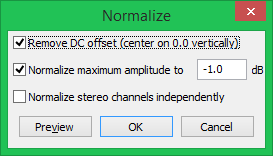
image The very first pass I make is to normalize the audio.  This helps to minimize the difference between the loudest volume speakers and the quietest volume speakers.  Now you can completely squash any difference in volume if you really like but you end up with robotic sounding audio.  I have personally found that I like the defaults pretty well.  This is an extremely fast edit so should not take a lot of time, but the final result can be very noticeable.

Noise Reduction

image This pass is primarily for if someone I am recording with has a significant amount of white noise or audio “hum” when they record.  For the majority of the time recording Aggrochat this was actually “me” that I was having to edit.  This pass is a little trickier because of the way this tool works.  Ultimately you need to highlight an area of the recording where the noise you want to extract is evident and use it as a sample using “Get Noise Profile”.  From there you run the complimentary command of “Reduce” to essentially cycle through your audio and filter out that noise.  It does a fairly good job but the more noise you filter, the lower the overall fidelity of your recording gets.  This really needs a fine touch because if you filter too much you end up with washboard sounding audio as a result.

Truncate Silence
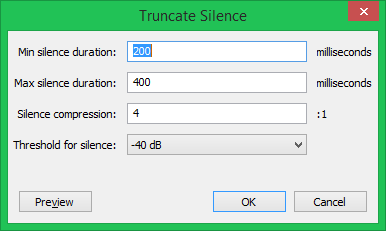
image If you have ever edited audio the thing you notice after the fact is just how many awkward pauses we make as human beings.  Going back and finding these and eliminating them is pure tedium.  I spent weeks doing this manually until it finally dawned on me.. that this should be something that is pretty easy to automate.  After a little research I found the “Truncate Silence” tool and it is going to be your new best friend.  What it does is essentially even out the silence in your track truncating any silences over a set amount and padding any that are under a certain amount.  These are the settings that I go with for AggroChat, for Bel Folks Stuff I move it up to 400 and 600 respectively to allow a little more room for contemplative silence.  Ultimately you will have to figure out what setting “feels” best to you.

Limit Your Futzing

You can literally spend hundreds of hours if you really wanted to obsessing over the wave form audio.  I have stared at ours enough that I can literally tell you which person is speaking at any given moment from the shape of their waveform audio.  Basically the end result is going to need to be something that you can live with, but at the same time does not take over your life as you keep editing and re-editing.  To make my life easier I have created these files that I refer to as the “Canon” file that includes everything a show needs minus a given weeks audio track.  I set these up once and then just paste the new audio into them before saving them out.  You too are going to find little tricks that you can do  to speed up your process.  On a good night I will have the MP3 audio of our podcast ready to post within thirty minutes of finishing recording.  The longer the recording the longer the edits will take, especially as you start doing things like noise removal.  Those take a significant amount of processing time.  Now that you have your audio recorded and ready to go, you are going to need a place to put it.  Tomorrow I am going to cover the hosting of your podcast and some other bookkeeping tasks like publicizing.  My hope is that someone will find this whole process useful and maybe it will spur on a few new Newbie Blogger Initiative podcasts as a result.

The Podcasting Bug – Part 1

Love of Spoken Word

I grew up with I guess what you would call a love of both the written and spoken word.   The moment I got access to my first copying machine, was the moment I first tried to create my own comics and magazines devoted to whatever I happened to be into.  When I got my first word processor I went through a renaissance of sorts in trying to publish information about the games I was playing and distribute it freely among anyone who was willing to take it off my hand.  So when I started blogging significantly later in life it was of no real shock.  I had been “trying” to publish my own content for years, just doing so with limited success.  I would be willing to bet that other bloggers “of a certain age” can tell very similar tales of youthful exuberance.  While I grew up in the MTV generation, my sentiments will more than likely always lay with the era when print media was king.

Another constant in my life however was Radio and Public Television.  I spent most of my childhood watching Nova and Mister Rogers Neighborhood, and when I rode around in my fathers truck it was almost always tuned to the radio station playing Paul Harvey.  When I started choosing my own radio stations to listen to I found the best use of my time to listen to NPR and use that morning lull as my way of catching up on the world.  From there I discovered so many broadcast programs that were more entertainment than education, and I was absolutely hooked.  In many ways podcasting is the extension of this love for the spoken word.  Some bloggers catch the bug, and feel like they have to move into doing something more than just writing.  This happened to me a little bit over a year ago and now I have two different podcasts to show for my obsession.  Many other attempt to maintain three for four different shows devoted to different segments of their experience.  If this is happening to you, I thought I would take a moment this morning to talk about some of the issues I had to deal with when approaching my first show.

Format

One of the first decisions you are going to have to make is what exactly you want your show to be about.  Just like with your blog you have to make a decision as to what you want your format to be.  Single game or single topic blogs and podcasts will be significantly more popular than generalist ones, however in my experience your audience will also be considerably more fickle.  If you listen to a Wildstar podcast religiously for example, and you stop playing Wildstar…  then your reason for listening to that podcast also goes out the window.  If you listen to a more general podcast you ultimately end up listening for the cast of people, and those sorts of listeners tend to be significantly more loyal.  That said all of the biggest podcasts that I know of tend to be devoted to a very specific niche.

For me personally I knew that there was no way in hell I would be turning this into a career so I was not extremely concerned about trying to get the biggest possible audience.  I am interested in a lot of different things, as are my friends… so for me it was a no brainer that we created AggroChat to reflect the conversations we already had on TeamSpeak on a regular basis.  In my experience podcasts tend to fall into four broad groups as far as the actual format goes.  I have listened to great podcasts that fall into each of these categories, and not so great podcasts as well.  Ultimately you have to pick whatever works best for your cast, which leads us to the next point.

Topic Focused

I chose to refer to this as topic focused, but more often than not this tends to mean a “News” show where the hosts cover a series of predetermined topics.  This requires you to keep good show notes and that they get circulated before the actual recording of the show.  Believe it or not we actually started AggroChat trying to follow this format, but quickly realized we were not the “planning” type people.  These tend to be the most “predictable” shows as far as recording time goes, since you have a clear list of goals that you want to accomplish in each show.

Conversational

This is ultimately the format that AggroChat became, because we are bad at having structure.  The idea here is to record a somewhat natural conversation with a group of people.  Topics flow in and out of the discussion and segway naturally.  The problem here is that this only works if the folks you are recording with are very very familiar with each other.  While the first format relies heavily on planning, this format is all about interpersonal chemistry.  I personally love this format, but I am sure there are just as many people who are annoyed by it.  This is not a format you can carry off if you are assembling a group of people that do not regularly spend time together.

Narrative

This is the podcast that tells a story.  There are many different versions of this but probably my two favorites are This American Life and Radio Lab.  This is the format that requires extreme planning but adds a whole new dimension…  that is significant amounts of post production editing.  When it works you have this wonderful audio journey through the story you are trying to tell.  When it doesn’t work, you end up with jarring gaps.  This is one of those formats that I aspire to try some day, but just don’t have the technical ability yet to really make it work.  If you are an audio editing wizard though this might be your natural format, mixing in clips and music to support the tale you are trying to weave.  The folks that can do this one will have my constant and undying respect.

Interview

This format is probably the most straight forward and at the same time extremely flexible.  The concept is simple, in that one or more hosts asks questions from one or more guests.  The challenge is in scheduling a constant flow of new guests to sit down and record with you.  You can put as much planning into this format as you need to, or you can do it completely off the cuff.  When I record “Bel Folks Stuff” for example I ask a few standard questions but the rest is taken from queues in the conversation and I try and go wherever the conversation wants to lead.  When Braxwolf records Beyond Bossfights he seems to have a master plan laid out in exactly what he wants to ask his guest.  Both work and both are completely viable methods, so ultimately you have to figure out which version works best for you.  Chances are you can even make a hybrid approach work a well.  This format relies mostly on the ability of the hosts to “coax” a performance out of their guests.

Casting

There are lots of different styles of podcasts and each of them have their own strengths and weaknesses.  The more people you add into a podcasting cast, the more chaotic the end result.  The fewer people you have, you lose some of the depth of having multiple opinions chime in on topics.  The “Solo” podcast is its own beast that I personally am not a huge fan of.  It always feels like I am being lectured to more than joining in on a conversation.  I am going to talk about a few of the styles that I have experienced and some of the strengths and weaknesses of each.

Solo Podcast

This is the traditional “one man show” to borrow the showbiz term.  You have an idea that you want to run with and you just start recording.  The problem here is that like I said above these shows tend to be extremely unbalanced sounding.  The solo podcast works well if you are telling a story, and going to be referring back to audio or music clips to help flesh out your narrative.  These shows also work amazingly well for five to ten minute “news update” type formats.  Where the format tends to grind on is when dealing with a thirty minute or longer show of just one voice talking.  The positive is you can literally record whenever you want to, and are not limited by other people to make your ideas work.  The negative is…  you have to carry all of the weight on your own shoulders.

Duo/Trio Podcast

I feel like the majority of podcasts fall into this category, where you have a preset group of two to three voices that present topics every single week.  This is the cornerstone of the podcast for a reason, because it works extremely well.  In three voices especially you can get just a wide enough range of opinion to make most topics work, but not have too many competing voices to let a discussion descend into chaos.  The challenge here then becomes scheduling.  Unless you can find a time every single week or whatever your recording schedule happens to be…  it becomes a juggling act trying to get all of the key players in the room at the same time to record a show.  I know many shows that will record multiple episodes in the same weekend and stagger their release to make up for scheduling conflicts.  I know personally we have done this twice with AggroChat and they made for some very long evenings.  Once you get into a routine then more than likely things will stabilize and get significantly easier.  Duo works well but the problem with Duo is when one person is gone… you have a solo podcast.  With a Trio you can limp through with just two people relatively successfully.

Ensemble Podcast

The ensemble cast is the most forgiving when it comes to scheduling conflicts.  It tends to draw on a large list of potential co-hosts and arranging as many of them as you can on a given night.  This is ultimately what AggroChat has turned into over time having had ten different people who have appeared with semi-regular frequency during the course of our time recording it.  Ultimately however in order to make it work you are going to need a large group of friends who are interested in podcasting.  The strength of this format is that you can incorporate new people easily and in a pinch you can record with significantly fewer people than normal.  The problem being that once you get over five people on a podcast it starts to get extremely chaotic.  We do our best to mitigate that problem with our format, but ultimately AggroChat is what it is… a rambling chaotic mess sometimes.  I feel the casting is extremely sustainable as recently Rae expressed interest in stopping the podcast for the time being, and we were able to work in a couple newer voices in her place.

Interview Podcast

This one is a very different beast in that essentially it is a solo podcast… with one additional guest that varies each time you record.  This is the format I chose for my Bel Folks Stuff podcast, and it has its own set of interesting challenges.  The key problem for me has always been scheduling people.  When dealing with a few people on a regular basis you can pick a single time to record that works for everyone.  When you are constantly changing who your “partner” is on a show by show basis you end up having to work with  the new persons schedule.  This has been pure hell for me at times considering a lot of the people I have wanted to talk to are in vastly different time zones.  This has completely destroyed any semblance of a release schedule for me, and as a result I have purposefully kept from submitting the show to TGEN because I never know when I will get time to record one.  I personally find the format gratifying  as a host because it allows me to have interesting long form conversations with “folks” that I care about.  Due to all of the problems I would highly suggest against this being your “primary” podcasting format.

Release Schedule

As with blogging the key to building a reliable audience is through regular and predictable release schedule.  There are people who start their day by reading my blog, because they know it will always be there waiting on them.  Similarly there are a series of podcasts that I start listening to Monday morning as I begin work because I know they will be reliably waiting on me.  As such I have found that the interval is not nearly as important as simply sticking to something.  I personally jumped in the deep end and started immediately with a “weekly” show.  This means every single week like clockwork you have to crank out a show, edit it, and get it posted and publicized.  AggroChat requires less editing than most shows out there, and still without a doubt this dominates my Saturday night and Sunday morning getting things ready for the world.  There are many nights that I go to sleep about 2 am after editing, and then still have to get up the next morning and deal with the publicizing.  This is the last point I am going to talk about today so I thought I would talk about a few of the release schedules that I have seen work.

Weekly

Like I said this one is at times sheer madness.  You are signing yourself up for a radical shift in your lifestyle to incorporate making a podcast into each and every week.  Depending on the type of podcast this can be easier or harder.  For example we use an ensemble cast, and Kodra is more than willing to “host” but I have never really cross trained anyone else on the whole “creation” process.  The positive here is that people LIKE listening to new content every week.  Your audience will grow faster because you are creating more content for them to consume.  We even have some insanely loyal listeners that have gone back through our entire back catalog of new 56 episodes.  Just realize that the weekly show is a massive challenge, and you have to be fairly stubborn to make it work.

Bi-Weekly

I hate the term bi-weekly because it means two things… twice a week or every other week.  In this case I am referring to the every other week schedule that several podcasts use.  This is still a strenuous schedule but gives people an “on” week and an “off” week to recuperate and plan things around.  I have been exceptionally lucky that I have a wife that supports the madness I am involved in, but for a lot of married couples locking away a night every week is going to be a problem, especially once you factor in children.  The bi-weekly schedule tends to be this happy medium making it equal parts flexible and manageable while still churning out enough content to get folks “hooked” on your format quickly.

Monthly

There are a myriad of issues with the monthly format.  For starters you have to be extremely careful when you schedule exactly when you want to record.  Theoretically you need to record with regular interval meaning you would need to release the first week of every month or some similar schedule.  The problem is life often sabotages you, and while it sounds good right now that we will record in three weeks…  there might be a birthday or an anniversary or some other hurdle that gets in the way.  I am horrible at keeping calendars so there is no way I could do a regular monthly show.  I release “Bel Folks Stuff” on a semi-monthly schedule, but I have actually missed an entire month before.  The big problem I see with a monthly show is that in theory you have to always have a great show.  When you do a weekly show, you can recover from having a shit week pretty easily.  When you are only releasing twelve shows a year… they all pretty much have to be golden to keep folks interested.

Recording Your Podcast

When I set down to talk about all of this I quickly realized that I would have to chunk this up over the course of multiple posts.  In this first part I focused on the “design” of your podcast.  In the next part I am going to focus on the nuts and bolts of recording your first episode.  The final part to follow after that will talk about the nuts and bolts of hosting.  My hope is that this inspires folks to go off and create their own podcast, but also inspires them to realize there is a lot of planning that goes into making it work.  As I am drafting the next pieces I would love to know if there are any specific things that you would like me to take a detour through and cover.

Foundation of Folks

Statistics Funk

One of the problems with creating content is every now and then you will have something that you are very proud of, but the community doesn’t seem to be all that interested in.  That is not to say that I am not proud of most of the things I am involved in.  I love what this blog has become, and I love AggroChat…   but that seems to be less about me and more about the group dynamic that we have assembled.  However I feel like “Bel Folks Stuff” was one of those projects that I poured more of myself into than most.  The idea was that I would grab interesting people and have natural conversations with them where we discussed whatever happened to be on their mind.  I feel like for the most part that mission has succeeded, and I am very proud of the six episodes we have so far.  In the episodes I have talked with:

  1. Gypsy Syl
  2. Rowanblaze and Sctrz
  3. Alternative Chat
  4. Petter Mårtensson
  5. Qelric
  6. Liore

Unfortunately after the release of the latest episode I did that thing you are never supposed to do… I did a deep dive into the statistics.  In many ways this secondary podcast has been a labor of love, and right now it gets several orders of magnitude fewer listeners than AggroChat.  So I question…  what I did wrong with it?  Maybe I have simply done a poor job of advertising it?  It isn’t part of The Gaming and Entertainment Network so that right there is one strike against it.  I release them with questionable regularity, which is another strike against it.  I also question whether or not it was a good idea to treat it as separate from the other things that I do.  I have wondered for awhile if I should have just released it as part of the AggroChat content stream.. as a sort of bonus episode or something.  In any case… since looking at the stats I am exceedingly bummed about the limited audience.  Maybe there just is not the appetite for listening to gamers rattle on?  Anyways… this isn’t going to necessarily stop me from making more but I also feel like my guests have been awesome in their willingness to do the show…  when there really isn’t much benefit from it.

Foundation of Folks

For some time now, I’ve had various people tell me that I use exercise any connections I have within the games industry to turn the “Folks” podcast into an industry interview show.  I suppose I could do that, but the problem is I am afraid that would fundamentally change the nature of the show.  It might be idealistic, but I wanted to create a show without pretense about its purpose.  I wanted to have people on and just talk, and whatever topics we happened to cover naturally is what we would end up talking about.  If I have people on the show that are known for this or that, there is the pressure to ask them about what they are famous for.  By the same token, I would feel obligated to give them time to plug whatever hot project they happen to be working on.  At that point we have a traditional interview show and not what I was hoping for.  Maybe it is strange but I was hoping to have authentic conversation with a bunch of people, and almost forget for a time that we were recording the conversation.

I guess I question if I could talk “industry” folks into that sort of notion.  So far the people I have had on the show I have a deep connection with already.  These are people that I have gamed with, blogged with, or exchanged more tweets than I can count.  Right now it feels like I am just having a conversation with a friend.  I worry that I cannot keep up that dynamic with people I am not quite so personally invested in.  Then there is the problem of how would I even sell this notion to someone, when I obviously cannot guarantee much in the way of listeners.  That is the obvious sell for most big podcasts… is “talk to me and I can give you X number of ears”.  I don’t have that going for me on any level.  So yeah right now I am in this existential funk about “Bel Folks Stuff” and even though I love doing it… I am questioning if it is worth the scheduling headaches and the extra work on my part to keep it up.  I want to keep it up, but damn…  just bummed.

Second Static

ffxiv 2015-04-05 19-27-29-95 Last night when I got home… I was wallowing in my frustration over the podcast…  so much so that I forgot that last night was to be the inaugural running of the second static group within the Free Company.  The guild has been insane, and we are apparently so active and so prevalent that we jumped from 16th to 6th in the FFXIV free company activity standings.  I will say for some time there has not been a single city I have been in that I did not at least bump into one person with the [GREY] tag.  In order to help get the second static off the ground, myself and Kodra has offered to fill in as whatever role they needed us in.  I ended up main tanking to Damai’s off tank as we managed to work through several content items.  So while I started the evening in a bit of a malaise I finished it pumped about the prospects of having two active static teams within our free company.

We started off with Garuda Extreme, which I know very well…  just not well enough to explain adequately apparently.  This always seems to be a thing for me… I can do something, but I can’t necessarily tell you how to do it.  For awhile we tried using the Duty Finder to fill our missing slots, but honestly had significantly more luck creating a party in the Party Finder.  We met a few nice people on the server as well.  We managed to clear Turn 1 and Turn 4 of Binding Coil of Bahamut as well.  I was pleased that we one shot 4, since I remember having a significant amount of trouble with it initially when Ashgar and I tanked it.  To add to the confusion for the sake of this arrangement… the roles were flipped from what I am most used to.  The positive is… I feel like I could actually farm four over and over in an attempt to get my bear mount.  I need to figure out which piece of high allagan I am missing so I can focus down those.  I would really love to wear that full set of gear.  Anyways the end of the evening was definitely better than the day, so I am thankful that I have such an awesome group of people to spend my game time with.

Race to the Bottom

Bel Folks Stuff #6 – A Good Friday with Liore

Listen to the Episode Here

I had these grand ideas about having two episodes during the month of March to make up for the fact that I missed a February episode.  That never quite worked out.  I had a handful of people that I had talked to but scheduling never quite worked out since I try really hard to squeeze these episodes in whenever my wife is otherwise busy.  With the weekly schedule of AggroChat and the various guest spots I end up getting called on to do, it means she is having to bend her time around me quite often, that I try my best not to make this podcast also do that.  As such I tend to schedule people on a whim, and I am super thankful that the amazing Liore was amicable about that sort of timing.  I literally talked to her Thursday to see if she was available, and we recorded on the afternoon of Good Friday since we were both off work.

Liore and I have known each other for what feels like forever.  She’s been in my guilds, I’ve been in her guilds… and for a period of time in Rift we raided together multiple times a week.  During all of this time we have forged an unconventional friendship.  It feels like we end up on opposite ends of so many discussions, but at the end of the day we do so with the greatest of respect for the other.  During this podcast we talk about all sorts of things, but one thing in particular we highlight because we found it extremely humorous.  Both of us have been getting commentary from the community about a supposedly rivalry between the two of us since we do similar columns now for gaming websites that are technically in competition with each other.  I had a blast spending the afternoon talking with Liore, and had I allowed myself to do so I could have easily spent another full hour chatting away.  I always love it when the conversation flows naturally.

Race to the Bottom

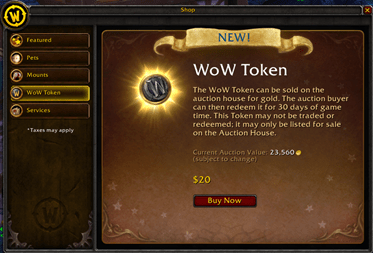
wowtokenresults Yesterday we saw the release of the WoW Token out into the wild, and the demand for gold greatly outstripped the availability of people snatching up subscription time.  At the beginning however it was skewing the other direction.  The token started at a prematurely low 30,000g and I watched it yesterday raise up to 35,000g before taking a big dive into the territory that it is currently sitting.  Someone thought ahead and created an excellent stock market like tracking system on https://wowtoken.info/ and you can see the bottom starting to drop out.  Thing is…  most players already have an active subscription for the moment.  It was not until the end of the month when in other games with similar systems we started to see the demand finally climb again.  My advice, just like Wildstar is to snatch up these cheap tokens now because once the system matures a bit you will be paying significantly more per month of subscription.

The reason why I feel like this is the largest benefit of a system like this is it removes the temptation of players to turn to less than legitimate sources of currency.  When I wrote about this a month ago, my research at the time indicated that in the aftermarket this same $20 was buying players around 100,000 gold.  This means the legitimate route now costs you roughly five times as much as the illegal market, which is still going to be a huge draw for some players.  The WoW Token is a failure for Blizzard unless they can squash the third party gold sellers by starving them of their market.  Right now the token is new… and a lot of people are trying it out.  Given a month or two of sanity they will realize that it is greatly overpriced.  I guess for me, I won’t be doing this token unless I can buy a couple and get a big ticket item like an expedition yak, one of those things I have always wanted but was much too far out of my price range.  I have a feeling that this is going to be the case for your average customer.   If by the end of the month we do not see a massive spike in the price of a single token… then I will be extremely surprised.

End of an Expansion

ffxiv 2015-04-07 17-25-22-55 Now for the hardest part of my morning… how exactly do I talk about the wrapping up of the storyline in Final Fantasy XIV 2.55 without giving any spoilers.  I chose a very careful screenshot out of the stack of them that I took because this one really doesn’t say much about what is going on.  In the most spoiler free fashion I can, I am going to talk about my impressions of the events.  I have to say Final Fantasy XIV knows how to end an expansion.  This is hands down the most satisfying and at the same time most anxious ending to an expansion I have ever experienced.  In games like World of Warcraft everything is generally resolved at the end, and all the loose bits tied up… because the intent is for that expansion to live on its own forever without actually continuing the storyline in the next expansion.  In Final Fantasy XIV…  every aspect of this closing means massive ramifications that will hopefully be resolved as we travel into Ishgard.  Instead of wrapping up the lose ends neatly… for each one that is concluded two more ends stand open waiting to be explored.

The awesome thing is… this game has proven that it WILL actually explore them.  How frustrating has it been in the past as games have hinted at things, that never saw fruition.  After all there are still I believe three portals under Wyrmrest temple that go nowhere, that will likely NEVER go anywhere because the narrative has moved on past the original plans.  I expect that each event that happens during the closing of “A Realm Reborn” is going to factor heavily into a future storyline chain.  It was a pretty shocking and brutal conclusion, but it makes me damned happy that I am playing this game.  I quite literally did not see this one coming, and I highly suggest you push hard so that you can see this content before the expansion.  I pushed through in part because my friend Ashgar said that the trailer that was releasing this Friday supposedly spoils some parts of this impact.  As the credits rolled they showed a number of scenes from the past block of content… and I have to say sometimes you lose sight on just how much we accomplished during “A Realm Reborn”.  I am extremely excited to see what happens as we turn our eyes “Heavensward”.